Supply chain labour rights laws
Updated: May 27
There are many laws and regulations that relate to forced labour and labour rights more generally. Most of them govern how employers should treat employees.
But business also has responsibilities to workers that contribute to its enterprise but whom it does not employ. That means workers in:
Supply chains
Its premises (such as cleaners, security guards, maintenance)
Contractors and sub-contractors
Franchisees
This post is sets out the logic behind those responsibilities - and summarises the current state of laws and regulations that business should be taking into account.
Human rights laws - the UN General Principles
In 2011, the United Nations unanimously adopted 31 guidelines together called the United Nations Guiding Principles on Business and Human Rights.
There are three core pillars:
Protection: states have a duty to profect individuals from human rights abuses and, through laws, policies and regulations, to direct business to do the same.
Respect: businesses have a responsibility to respect human rights and they should adopt suitable policies and conduct due diligence.
Remedy: victims of human rights abuses must have access to judicial and non-judicial remedies.
The principles include the concept of "leverage". This is the abiltiy to effect change in the wrongful practices of another party - and it applies to businesses that purchae products or services from supply chains.
Taken together, the UN GPs set out that business should conduct due diligence to check that supply chains are operating without abuses of human rights, and if abuses are detected, should use their leverage as a customer to ensure remedy is provided to the affected rightsholders.
Most of the current laws and regulations are rooted in the principles of the UN GPs.
Current supply chain labour rights laws
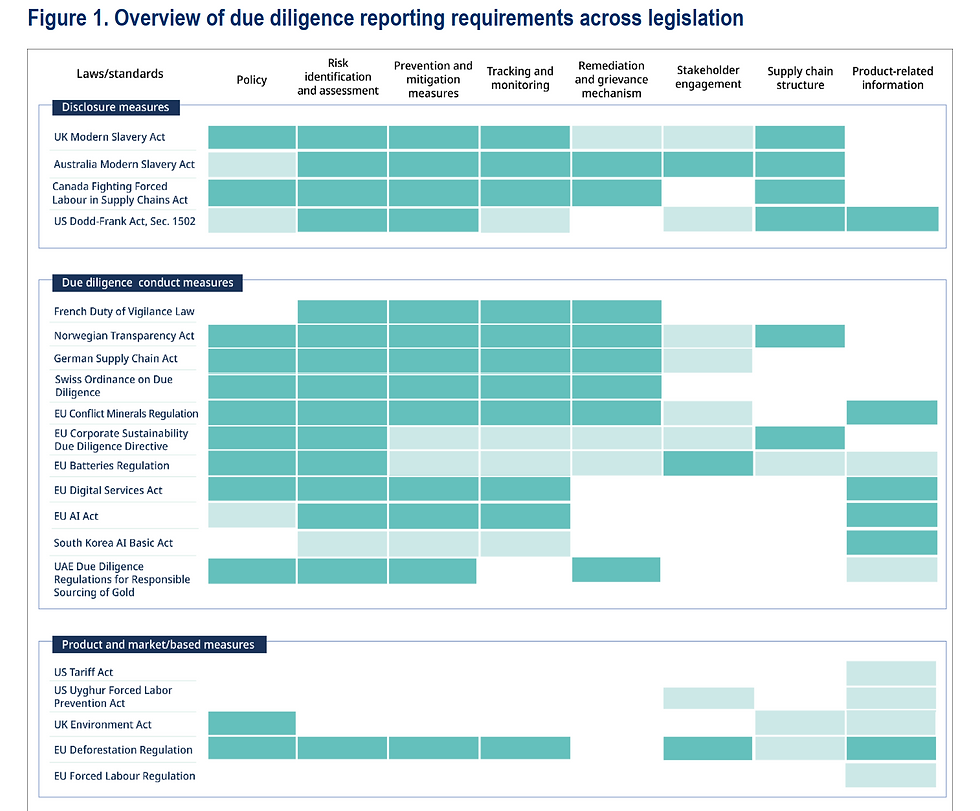
The OECD has produced a useful mapping of social and environmental due diligence legislation, covering 21 measures across 11 jurisdictions.
They have split the different legal measures into three types:
Disclosure measures (duties to report)
Due diligence conduct measures (duties to investigate)
Product/market based measures (specific laws for specific sectors)
Across the different regulations, there are obligations to act (eg: conduct due diligence), obligations to report (provide information about what has been done) and, in the product/market based measures, strict obligations not breach the rights of rights holders.
Most of the regulations apply only to bigger businesses and many of the regulations lack strong enforcement processes. But many of the regulations are extra-territorial in that they apply to businesses operating in a market regardless of where those businesses may be based.
The 21 regulations mentioned here include:
Modern Slavery Acts (and equivalent) of UK, Australia, Canada and in the US
Due diligence laws of the EU (CSDDD), Germany (the Lieferkettengesetz), France (Duty of Vigilience Law), Norway (Norweigen Transparency Act)
Forced labour prevention laws such as FLPA (EU), UFLPA and the Tariff Act (US)
But how are these laws translating into actions in practice?
Supply chain labour rights in practice
It has taken a while for new legal environments to catch up with existing business practices - but this is now becoming visible.
The "duties to report" laws are only of mild interest in practice - as there is no evidence that there has been any actions taken for obvious breaches or failures to disclose properly.
But there are three areas where action is happening:
Laws against importing products made with forced labour
Laws requiring businesses to conduct due diligence
Court cases brought under general legal principles
There's plenty written about WROs in respect of the US UFLPA and the Tariff Act - but we should note that there only around 50 active WROs at the time of writing (April 2026) - which is not many given the scale of US imports. Although these regulations have teeth, there is not much biting going on.
The most interesting areas are with the laws requiring business to conduct due diligence and actions being brought under general legal principles.
Nearly all of the measures rely on civil society to police them.
If potential breaches are detected, someone has to raise a complaint with an enforcing body - since governments allocate meagre resources themselves to policing the laws that they may have enacted in this area.
Although business may often privately bemoan the impact of activist groups and not-for-profits on their brands and reputations - these groups are providing a valuable service to society here, and also helping to ensure a level playing field. No business wants to lose market share to a competitor who is undercutting prices by playing fast and loose with labour rights in its supply chains.
Legal actions relating to labour rights abuses
Where countries have enacted laws the require business to undertake due diligence, we can see actions emerging.
Many household names are in focus there, particularly across France and Germany where there are have been specific domestic laws in force for a while requiring business to undertake reasonable due diligence.
Complaints focus on a failure to that conduct reasonable due diligence (ie: a failure to act in accordance with the law), evidenced by labour rights or human rights breaches arising in supply chains that have been ignored after disclosure or which have gone un-detected.
The list includes: Amazon, Yves Rocher, Edeka, Ikea, a number of major apparel retailers.
And there is real liability here for companies, noting the substantial fine recently imposed on Yves Rocher in a Paris court.
On top there are civil actions. These are being brought in the UK and the US under general legal principles - most notably class actions brought by workers against Dyson and Tesco in the UK and against Starbucks in the US.
Retrospective effects - a duty of care?
New laws generally take effect from a date - eg: the EU FLPA (Forced Labour Prevention Act) becomes binding on business from 14th December 2027.
But there are situations where court decisions can have retrospective impacts.
When a group of workers brings a class action under general principles of law, the main question being debated is whether business has a "duty of care" in respect of workers that it does not employ, but where it benefits from their labour.
That means workers in its supply chains.
And the logic is that, if business benefits from labour rights being abused in supply chains, it can have liability to those workers if it is casual about those abuses.
We might predict that, at some point in the UK, a case will come to court and a judge will find in favour of the workers. The issue was not addressed by Dyson as that case in the UK recently settled out of court - but there will be cases that come to court at some point.
The argument is:
Worker rights were compromised, leading to lower cost products being supplied
You benefited from those lower input prices.
You should have known this was going on (ie: you negligently turned a blind eye), and you did not do anything about it.
We have benefit, causation and negligence - and this can lead to liability in English law.
And if the courts find that business does have a duty of care - which, on the face of it, seems reasonable - their rulings will have retrospective effect. Liability will exist today - even if that ruling occurs in the future.
That's because the duty of care to workers will always have been there - whether or not anyone paid attention to it.
We are all on notice!
Where next?
Governments are understanding that duties to report are not enough. See the guidance from the UK government on tackling modern slavery.
There is an increasing shift towards laws that require due diligence - and these laws have teeth as long as there are civil groups who are vigilant and engaged in policing their implementation.
Laws against importing goods made with forced labour are clearly a good thing - but they are operating with limited effect today. It remains to be seen how strongly the EU enforces its own Forced Labour Preventation Act (FLPA) that is due to be in force in 2027.
Around the world, it is clear that business is being expected to do more policing of its supply chains - and there are material liabilities that may be accruing today for businesses that are not taking enough care.