
What Is Worker Voice for?
For most labour rights practioners and ethical sourcing teams, "worker voice" means a system to canvas feedback directly from workers in supply chains about their working conditions.
Many businesses have tried this corporate form of worker voice — and they have not always been happy with the results. Feedback may lack authenticity, programmes may have been expensive to set up and difficult to scale, whilst results may have required significant effort and cost to digest.
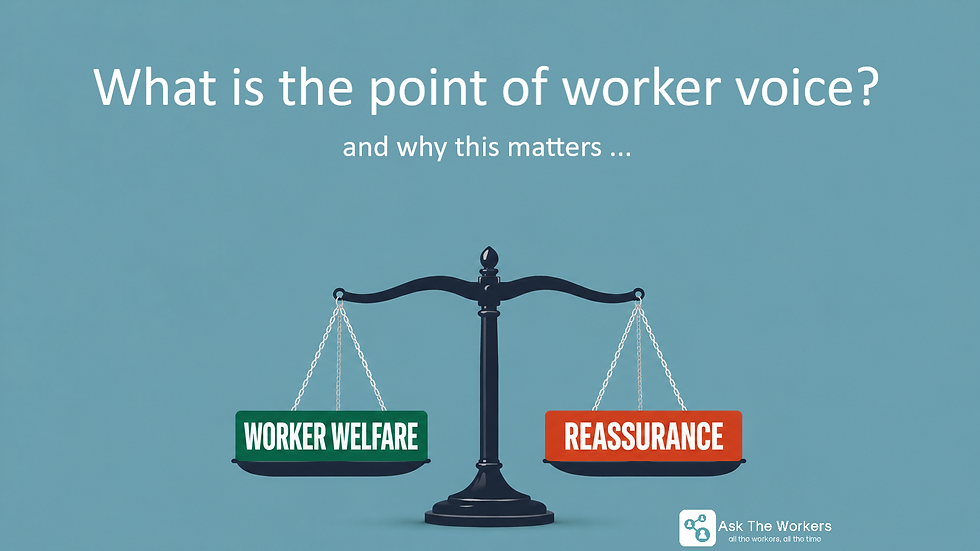
Getting worker voice right requires clarity over its purpose and setting up programmes that work in the right way.
This means being very clear on a central question:
What is worker voice actually for?
Getting this wrong is the most common reason worker voice programmes disappoint their sponsors.
Two different objectives
There are, broadly, two ways to think about the purpose of worker voice.
The first is reassurance.
The sponsor — a retailer, brand, or financial institution — wants confidence that the labour rights commitments made by its suppliers are being observed in practice.
Worker voice is a monitoring tool.
Worker voice is a way of checking that conditions are acceptable, that policies are being implemented, and that there are no serious issues that audits might have missed. It is fundamentally about managing the sponsor's risk.
The second is equity.
Worker voice exists to give workers a genuine channel to surface their concerns and to support an appropriate response from the businesses involved - building social equity in the supply chain.
On this view, worker voice is not primarily about the sponsor's comfort.
Worker voice is about worker welfare.
The social purpose is to improve working conditions when improvement is needed.
These two objectives are not always in conflict. But the tension between them is real, and it goes to the heart of what enables a worker voice programme managed by a corporate sponsor to deliver for everyone involved.
Two models for what Worker voice is in practice
The reassurance model
A programme designed primarily for reassurance tends to be built around the sponsor's needs:
Questions may reflect concerns that are risks to the sponsor rather than matters that might be of concern to workers themselves
Worker participation is compulsory or is managed to generate sufficient response rates — it is not necessarily voluntary
Results are reported in ways that support existing narratives
Workplace management can be heavily involved, controlling the process, the messaging, and any findings that arise
The model is optimised for the benefit of business interests rather than workers.
Workers sense this quickly.
When feedback produces no visible change — when issues are raised and nothing happens — trust evaporates.
Participation has to be compulsory or it declines. Responses become less honest. The programme superficially delivers the reassurance it was designed for, but the data behind it lacks authenticity and depth.
The equitable model
A programme designed around social equity - and possibly remedy - works differently.
The commitment to act when issues are surfaced is established upfront — by each workplace with the support of the sponsor in the background.
Workers experience over time that raising concerns produces results.
Trust builds.
Dialogue between workers and workplaces increases, better aligning the rights and interests of both parties.
Participation is truly voluntary and becomes sustained, especially if workers provide feedback in their own time and are compensated for it.
Responses are authentic and not controlled or influenced by workplace management. The data is real, deep, and useful.
When the feedback provided by workers benefits workers - participation builds and worker voice platforms deliver the data that sponsors are looking for.
The industry agrees
The Ethical Trading Initiative has long argued that worker-driven processes consistently outperform management-led ones in surfacing genuine issues.
The ILO's work on grievance mechanisms reinforces the same point: mechanisms that workers trust produce better outcomes than those designed primarily for the benefit of buyers.
These are not just ethical arguments. Regulation is tightening in ways that make this distinction matter commercially too. The UN Guiding Principles on Business and Human Rights and emerging mandatory due diligence frameworks across Europe make clear that meaningful worker engagement — engagement that actually identifies and addresses issues — is what is required.
Box-ticking is not a defence.
Reassurance and equity - you can have both
Authenticity cannot be engineered.
Workers who do not believe the process is equitable will not provide the honest feedback that makes the data valuable.

But once the social purpose of worker voice is recognised in the way worker voice programmes are designed, the reassurance goal is naturally delivered.
Social purpose separates programmes workers trust from ones they merely tolerate.
Best practice in worker voice puts social equity at its heart - but then also maps the feedback provided by workers into dynamic, easy-to-understand data flows that sponsors can map into their existing due diligence systems.
The good news is that getting this right is entirely achievable — and the rewards, for workers, workplaces and sponsors alike are substantial.
In our next post, we run through what "best practice in worker voice" looks like - delivering on the needs of sponsors, workplaces and workers.
Talk to us about worker voice
If you are exploring worker voice for your supply chain — or reassessing a programme that you would like to improve — we would be glad to help.
Contact us at info@es3g.com or book a call directly here.


