
Worker voice and AI
There is a lot of talk about AI. There is a lot of talk about worker voice, meaningful stakeholder engagement and decent work.
Change is upon us - whether that means changes to labour rights due diligence driven by legislation - or organisational changes driven by the emergence of new technologies.
We explain here how we use AI with continuous worker voice data to generate new insights and to reduce the workload for our clients.
Meaningful stakeholder engagement is a dialogue.
That dialogue should happen between workers and their workplaces continuously
Third parties with leverage listen in to make sure the dialogue is effective.
This is an ideal use case for AI, amplifying worker voice to pull out key and important signals, and putting them into context for users - helping the dialogue to happen.
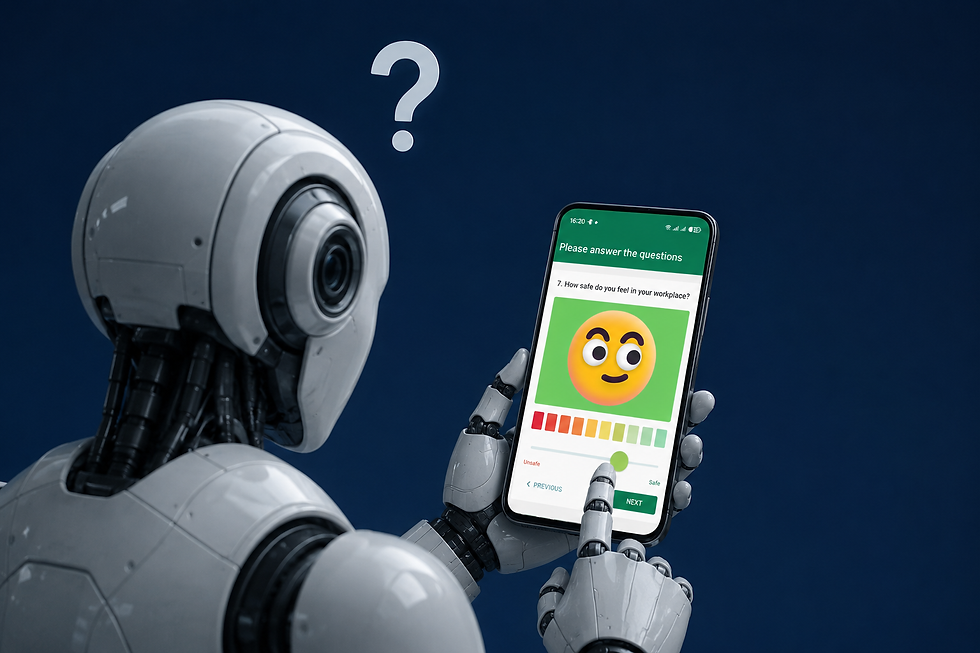
Ask The Workers, AI and continuous worker voice
Ask The Workers is a leading worker voice platform, delivering continuous worker voice.
This is not a survey, it is data arriving at scale every day, directly from workers about their day-to-day working life. Our app covers all-the-workers, all-the-time. Workers use our app on their phone to provide voluntary, anonymous, and authentic feedback without typing whenever they wish.
We use AI in our platform to help us present what workers are saying clearly to our clients and to the workplaces involved.
AI, worker voice, lots of data
AI is only as good as the inputs it receives - the data, the prompts, the guardrails.
This is where continuous worker voice and the Ask The Workers team have real strengths.
With 75 and more questions being answered across a workforce multiple times every day, we have a lot of data. Some of our tables scale to millions of rows. This data is high quality because it is provided voluntarily, anonymously, 100% digitally, and usually unsupervised. We do not know the identities of the workers using our app - and neither do their employers(!)
This large amount of data can be challenging to interpret. We do not want to ask our users to run many reports and look through many screens to understand what workers are saying.
Moreover, whilst there may be negative signals, these need to be put in context. We ask, for example, 10 different questions in our base question set on living wages. If workers report dissatisfaction with 1 question (eg: sick pay) but report comfort with others (eg: regular wages are paid in full, and regular wages are paid on time) - then that context becomes important.
Most of our clients are under time-pressure with limited resources stretched across large numbers of suppliers. And this is where well-designed dashboards and AI processing can enhance interpretation whilst saving users a lot of time.
Ask The Workers dashboards
Our dashboards are powerful, intuitive and easy to use. They include automated flagging systems with sensitivity levels that users control, and trend analysis so that findings can be analysed in context over time. Users can even drill down to daily detail on individual questions if they need.
But many users only want to use these functions for investigations. What about the regular monthly reporting cycle? What about a summary report for a supplier visit? How do we share meaningful information with colleagues in procurement or senior management who are not experts in labour rights?
Here is where AI reporting becomes really valuable. In our experience, there is no "one-size-fits-all" summary of a workplace or a group of workplaces. The dynamics across the data vary considerably.
At the push of a button, users can trigger an AI review of their entire supplier base, an individual supplier and even, should they need it, an individual labour provider. Our platform pulls the relevant dataset out and processes it through AI and generates a report. Takes about a minute - and it works at scale (coping with 1000s of workplaces including up to 12 months history for each).
These reports are able to bring all the data together, delivering a balanced analysis that can form the basis of internal reviews within the team - but also external communications where needed. Reports pull out what's important, but also put any findings in context so that balance is achieved.
AI is not as easy as it sounds
If you have been following our AI journey, you will know that we have already built some AI-powered tools. You can see one on our ES3G website (this website), for example - check out our "chat bot" in the bottom right hand corner. This is AI-powered.

From a technical point of view, we cannot throw large datasets into AI systems and expect a timely or efficient response. Most AI systems reject large files outright and get confused if a lot of data that is not properly structured arrives or prompts are not carefully engineered.
So we have to "wrangle" the data to reduce its complexity and scale without losing important detail.
We then have to build guardrails and appropriate prompts, with reference supports and clear instructions - which ensure the AI is boxed into a controlled process. We have to strip confidential information out of anything that goes out of the platform - restoring that data after the AI process to enrich the report locally.
The report the AI produces is also not what users really need. We have to ingest what comes back and then combine it with locally available data to provide a useful picture for users.
These "staging" processes are also very valuable for enterprises looking to integrate supply chain data into their own central AI strategy. The inputs we use with AI are also the inputs that central teams in the enterprise are likely looking for.
Our AI-powered reports are good. AI can make mistakes - so reports have to be reviewed.
But the signs are strong that the newest and most sophisticated LLMs (AI models), properly instructed, can be trusted to produce consistent and valuable analysis and reports - and the need to check will go down over time.
Ask us about AI
Many of our clients are looking at how to use AI to support responsible purchasing, ethical sourcing and to understand better the labour rights landscape of their enterprise.
We are an unusual team with deep expertise across deep tech, AI and labour rights.
We are happy to share our approach and show, in detail:
how we connect AI into our platform
data wrangling steps and techniques
safeguarding of confidential information and
prompt engineering
Just ask us for call?
Contact us at info@es3g.com or book a call directly here.


