

What it is, why it matters - learn about worker voice and best practice use of worker voice technologies.
Definition: worker voice (and "employee voice") means worker feedback, sentiment and views as they relate to their working environment and lived working experience.
An objective of worker voice is to provide workers with the ability to express their views and for those views to influence business decisions that affect their work.
Technology can be used to amplify worker voice and to foster dialogue between business and workers. Dialogue can lead to improvements in worker welfare and to decent work. Worker voice best practice is to use continuous worker voice technology supported by AI so that dialogue can be regular, evidence-based, effective and supported by third parties with leverage.
Worker voice
Introduction
As defined above, worker voice is feedback from workers and employees on their working experience.
Businesses, investors, and regulators increasingly recognise that without direct input from workers (worker voice, employee voice), it is impossible to identify real risks, verify compliance, or meet regulatory requirements focussed on ensuring decent work for all, including in supply chains.
Labour rights and human rights due diligence requirements are tightening as governments and society more generally seek to elevate labour rights standards for businesses in their own countries and the supply chains that feed them.
Including worker voice and employee voice in standard human rights and labour rights due diligence processes enables business to focus on worker welfare, rather than on data collection.
New regulations are bringing "worker voice" into focus:
-
How should feedback from workers be collected and how often?
-
What would best practice look like, how can businesses using worker voice platforms go beyond data collection to include focus on worker welfare?
-
What is the best way to assess feedback to ensure it is authentic and representative of actual conditions, can AI play a role here?
-
What should be done with the resulting information - how should it be assessed, what is the best way to ensure risks identified get addressed - and decent work gets delivered for all?
Today's typical connections between business and workers in supply chains have limitations:
-
Supplier self-assessment questionnaires, a commonly-used labour-rights due diligence tool, do not involve any connection with workers.
-
Social audits and surveys have greater or lesser connections but are snapshot processes that capture a picture only at a specific point in time; depending on how they are carried out, worker involvement may be influenced by supplier management.
-
Grievance mechanisms, if well-implemented and managed by external parties, can provide a valuable channel for worker feedback; but that channel usually only gives a limited picture of systemic risks given it relies on individuals speaking up, so signals can be intermittent, many risks can be missed, and it can be difficult to gain a consistent and reliable picture of conditions as they are being generally experienced.
True worker voice would be a fully-worker-represented environment where workers are present in business decision-making to safeguard their interests. This is not where we are - nor is it reasonable to achieve. It is not how things work. So any approach to worker voice is necessarily a compromise between the cost to business of a worker-first model versus the cost to society of a system that does not take worker labour rights fully into account.
Technology (worker voice systems or worker voice platforms) can help to address the balance of interests here - providing a low-cost way to surface reliable feedback from workers, whilst leaving it up to business to decide how best to respond to findings that emerge - but providing the concrete and authenticated data that can drive efficient decision-making.
👉 See more: Using worker voice flags to make it easy for business

Tea workers - an ideal use case for worker voice
This article aims to provide a balanced view of how worker voice technology can be used both to give workers a voice and, with best practice implementation, ensure that feedback is authentic, freely-given, useful and can be used safely to evaluate risk and deliver sustainable remedy to workers if this is required.
This topic is fully aligned with the growing business focus on "effective due diligence" and "meaningful stakeholder engagement". It is becoming very important to understand how to connect efficiently with workers and go beyond the scope of the current four tools available (SAQ, social audit, survey, grievance).
This authoritative guide explains:
-
What worker voice means in practice
-
Why traditional due diligence methods can fall short
-
How continuous worker voice can be used as part of a two-way process to collect valuable and actionable data whilst also leading to improvements in worker welfare where required
👉 See more: the human side - a Letter from Kolkata
What is worker voice in supply chains?
Worker voice in supply chain or labour rights due diligence refers to systems or platforms that enable workers to:
-
Share feedback safely and anonymously
-
Report issues directly
-
Hear back from workplaces about the feedback given and any remedies if they are warranted
In supply chains, worker voice is critical because:
-
How workers are treated can create invisible risks for business
-
Risks can change continuously
-
Relying on narratives that workplaces can largely control (eg: SAQs, self-arranged audits) is not enough and can provide false comfort

The five steps involved in implementing worker voice
Traditional compliance tools generally ask workplaces to self-certify their compliance, either directly or via processes where the workplace can manage the narrative. Worker voice enables business to check independently. Provided workers feel safe and anonymous and the process is simple, they can tell you if policies are implemented in practice. If workers also receive a benefit from the feedback they give, they are also likely to tell you voluntarily.
If your ethical sourcing policies are not effective, you could be increasing your risks if you go public with ethical commitments:
👉 See: Your ethical sourcing policies may be increasing your risks
Why worker voice matters now?
Worker voice, as a due diligence tool, has moved from a “nice to have” to a core requirement. This is to ensure due diligence is effective.
1. Regulatory Pressure
New laws and regulations (eg: MSA, CSDDD, FLPA, UFLPA etc) built on mandatory human rights due diligence (HRDD) increasingly require:
-
Ongoing monitoring
-
Evidence of impact
-
Meaningful stakeholder engagement - which means you need to ask the workers.
👉 See: Who are the stakeholders in supply chain due diligence?
2. Real liabilities are emerging
Existing laws are being used to hold organisations to account for labour rights abuses in their own locations and in their supply chains.
-
Making payments for products made with forced labour may be a crime - for you and for your bankers
-
Class actions are being brought by workers
-
Goods are being stopped at borders, companies are being fined
3. Limitations of audits
Social audits:
-
Capture a moment in time
-
Are often set up in a way that enables the workplace to control the narrative
-
Often fail to detect issues
👉 See: How effective are your labour / labor rights due diligence tools?
4. Demand for real data
Stakeholders now expect:
-
Evidence, not policies
-
Worker-level data
-
Continuous insight
👉 See: Sharing worker data - data should be given voluntarily

Shining a light on labour rights with continuous worker voice
Audits and feedback from workers
Most audit processes do involve collecting feedback directly from workers.
That can be some one-on-one interviews and by talking to groups - as well as walking the floors and observing how workers are being treated and behaving.

Worker voice and ETI base codes - effectiveness versus social audit
Social audits and "Supplier SAQs" (supplier self-assessment questionnaires) are generally a business-to-business arrangement. Management at the supplier can usually control the narrative. That's either because they are the only party answering questions (SAQ) or because they can largely supervise and manage the process (social audit). If workers are involved, it is usually only a small number and the supplier knows who they are.
All this means that there can be confirmation that policies are in place, but very little confirmation that policies are implemented in practice.
And, unfortunately, it is the practice that matters. A policy not to pay recruitment fees is good - but is this also the reality of the business.
For this reason, the SAQ and social audit side of our chart shows most of the ETI base codes coloured yellow or red for effectiveness (ie: no information or low visibility).
Worker voice is different - especially if it is continuous. Whilst suppliers will not tell you if things are not right, workers will tell you as long as they feel safe, there is a benefit to providing their data and they know what is going to happen to the data they provide.
Continuous worker voice is an effective due diligence tool - and it enables us to give a green colour to the ETI base codes under the worker voice column in the chart.
👉 Check out: this part of our "Effective ethical sourcing series"
The problem with traditional worker voice approaches
Most “worker voice” systems rely on:
-
Periodic surveys
-
Hotline reporting
-
Supplier-controlled mechanisms
These approaches conventionally have limited effect because they suffer from the similar limitations to social audits.

Table comparing continuous worker voice to surveys and highlighting the benefits of the continuous approach
Lack of anonymity - surveys are often supervised
-
Workers may fear retaliation.
Grievance mechanisms are individual
-
There is no safety in numbers
-
Grievance mechanisms may not be independent and "worker first"
-
Feedback may not actionable if it is provided anonymously
Surveys have limited reach or are not voluntary
-
Data provided may not be that authentic or useful.
Infrequent data
-
Time periods between surveys are not covered.
Low trust
-
Workers often do not believe feedback will lead to change.
👉 Understand what goes wrong: Improving on worker voice surveys
What does effective worker voice look like?
A modern worker voice platform should:
Reach all workers
-
Not just samples or selected groups.
Operate continuously
-
Capturing real-time changes in conditions.
Guarantee anonymity
-
Ensuring honest, reliable input.
Deliver actionable insights
-
Turning worker feedback into decision-making data.

UN sustainable development goals (SDGs) and worker voice
Effective worker voice delivers on 10 of the 17 UN sustainable development goals.
Most importantly: effective worker voice is about worker welfare and is not purely a data-collection exercise. Workers take risks when they provide information about their workplaces, especially if their feedback might be mixed. Worker voice should deliver benefits to workers - or they will not provide authentic data and participation will either be forced (leads to data being of questionable value) or low (also not what is really wanted).
👉 See: What is worker voice for?
👉 See: CFO briefing on worker voice - the return on investment
Continuous worker voice addresses the issues
A continuous platform is not a series of repeated surveys - it operates all the time and is designed to deliver true daily feedback from workers at scale.
Ask The Workers is an example of a continuous worker voice platform.
Key characteristics include:
-
Daily, real-time worker engagement
-
Anonymous participation
-
Zero cost to workers
-
Coverage across entire workforces

This approach provides:
-
High-quality data
-
Reliable insight into working conditions
-
Alignment with ILO and ETI standards
How to implement worker voice in your supply chain
Key steps:
1. Define your objectives
-
Data collection - this can be a strong motive - we need to know how workers are being treated and for that we need data. But best practice is to focus on establishing a dialogue with workers where they provide feedback (via an app, for example), then they hear back from their workplace what has been heard, and they get a remedy if one is required. In other words, go beyond data collection and consider worker voices as a tool to help improve worker welfare more generally. Design the program including the workers' point of view.
-
If the methodology and approach goes beyond data collection, worker voice can then validly support:
-
Risk detection, risk mitigation
-
Compliance, reporting, and analysis
-
Improvements in worker welfare if needed - which can lead to stronger and more resilient supply chains, better quality production and stronger credentials for both the supplier and its customers.
-
2. Ensure the workplace relationship is set up correctly
-
Best practice is to use worker voice to enhance dialogue between workers and their employers, with the sponsor (remotely) eavesdropping
-
That means
-
workplaces should understand that feedback is seriously provided and they should be ready to communicate with workers based on what is highlighted
-
sponsor involvement should be visible to workers to build trust in the process
-
but remedy is delivered locally, and the sponsor's role is to use its leverage where needed
-
3. Choose the right model
-
Scale (all the workers)
-
Frequency (all the time)
-
Anonymous, voluntary, compensated, two-way
4. Integrate with HRDD / LRDD
For the sponsor, ensure worker voice feeds into:
-
Risk assessments
-
Reporting frameworks
-
Decision-making processes
-
Responsible sourcing

Worker voice implementation - both workplaces and sponsors should see the data at the same time
From surveys to continuous worker voice
The key shift in the industry is:
❌ Periodic surveys
→ ✅ Continuous worker engagement
Continuous worker voice enables:
-
Daily feedback collection
-
Early detection of risks
-
Ongoing visibility across supply chains

Continuous worker voice data showing trends over time - participation levels and ETI base code tracking
Continous worker voice can be very simple to implement - and can cost 50% or even less when compared to worker voice survey programs.
The reason why it is lower cost is because there are no humans in between the data collected from workers and real-time dashboards. Once continuous worker voice is running, it just continues.
👉 Learn more: Continuous worker voice - what it is, how it works
Worker voice and labour rights due diligence
Worker voice is central to effective HRDD because it enables:
-
Direct identification of risks
-
Continuous monitoring
-
Meaningful stakeholder engagement
-
Evidence-based reporting

5 steps of labour rights due diligence - steps 4 and 5 are the challenges that worker voice addresses
Without worker voice, due diligence relies on:
-
Incomplete data
-
Assumptions
-
Retrospective analysis
👉 See why workplaces should do this: Suppliers and continuous worker voice - why support it?
Effective ethical sourcing: worker voice, audits and surveys
Audits and surveys are usually:
-
Periodic
-
External
-
Predictable
-
Limited sample
-
Often managed / controlled by workplaces
Worker voice is:
-
Continuous
-
Worker-driven
-
Truly anonymous
-
All workers and voluntary
-
Independent

Which due labour rights due diligence tools to use where?
Sourcing needs to be effective and be supported by meaningful engagement with stakeholders - which means workers.
👉 Deep dive: Effective ethical sourcing part 1 - the overall approach
👉 Deep dive: Effective ethical sourcing part 2 - what is reasonable to cover risks
👉 Deep dive: Effective ethical sourcing part 3 - what to do if harms are detected
Use cases for worker voice
Worker voice can be used to:
-
Monitor labour conditions across suppliers
-
Detect risks early
-
Validate compliance claims
-
Support ESG reporting
-
Strengthen supplier relationships
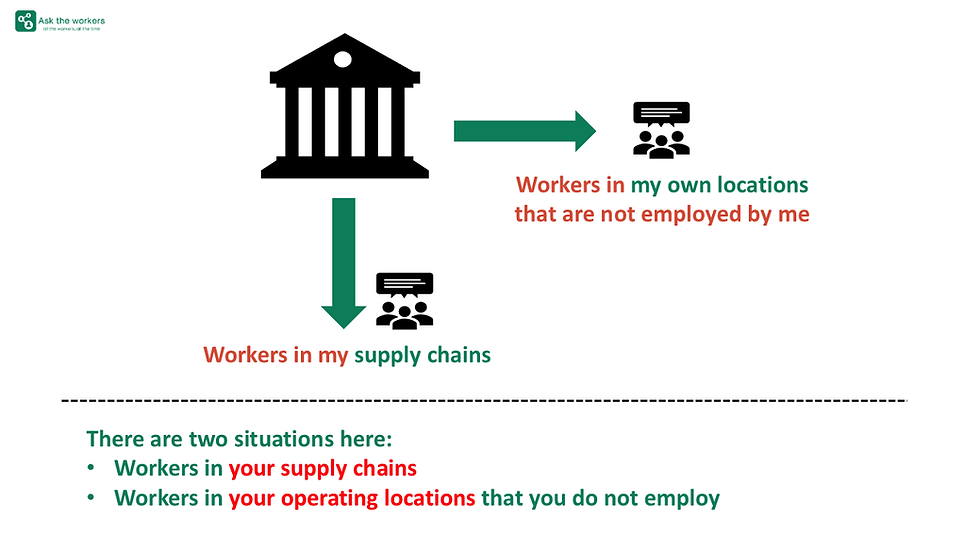
Labour rights risks are in two big areas: locations I am responsible for (where others are working) and my own supply chain (my suppliers and their suppliers etc)
The most well-known use case is for FMCG supply chains - particularly when emerging market suppliers are involved. Food supply chains are also a focus, especially in the ready-meals and across all steps between "farm-and-fork".
Use cases also include landlords, construction sites, franchisors, financial institutions (monitoring labour rights in labour suppliers - eg: cleaners, security guards, low-wage staff, contractors, sub-contractors).
👉 See more: Labour rights - a new focus - new areas of labour rights risks
The future of worker voice
The direction is clear:
-
From audits → continuous monitoring
-
From policies → data
-
From assumptions → worker-led insight
Organisations that adopt continuous worker voice will:
-
Identify risks earlier
-
Improve outcomes for workers
-
Meet regulatory expectations more effectively

The US uses section 301 to target tariffs at countries with high forced labour risks themselves or in their supply chains (because local laws do not prevent or do not enforce bans on imports made with forced labour)
Moreover, forced labour (or technically labor spelt the US-way) is reaching new levels of visibility as a result of recent initiatives in the US - which will, inevitably, lead to a greater focus on what is being done around the world.
👉 Maybe Donald did a good thing: Section 301 and forced labor - a tool to drive tariffs?
Conclusion - worker voice is no longer optional
Worker voice is no longer optional—it is fundamental to understanding and managing supply chain risk.
Meaningful stakeholder engagement requires frequent, two-way, discussions with stakeholders - and the most important stakeholder is the worker, the "rights-holder".
Due diligence needs to be effective - new laws, regulations and court cases are showing that simply asking suppliers to sign up to policies is not due diligence and it is not sufficiently effective. Business needs to go beyond audit.
And the regulations are here or coming - whether that is MSA, CSDDD, FLPA, UFLPA, new tariff regimes in the US etc ..
The challenge is not whether to implement worker voice, but how to do it effectively.

Worker voice - images from a garment factory implementation in Bangladesh
Effective, low-cost and scalable worker voice is continuous.
Continuous, worker-driven systems represent the next stage in supply chain transparency and accountability.