Worker voice best practice
Businesses and their suppliers are investing seriously in understanding the lived experience of the workers who make their products.
Worker voice is at the centre of that effort.
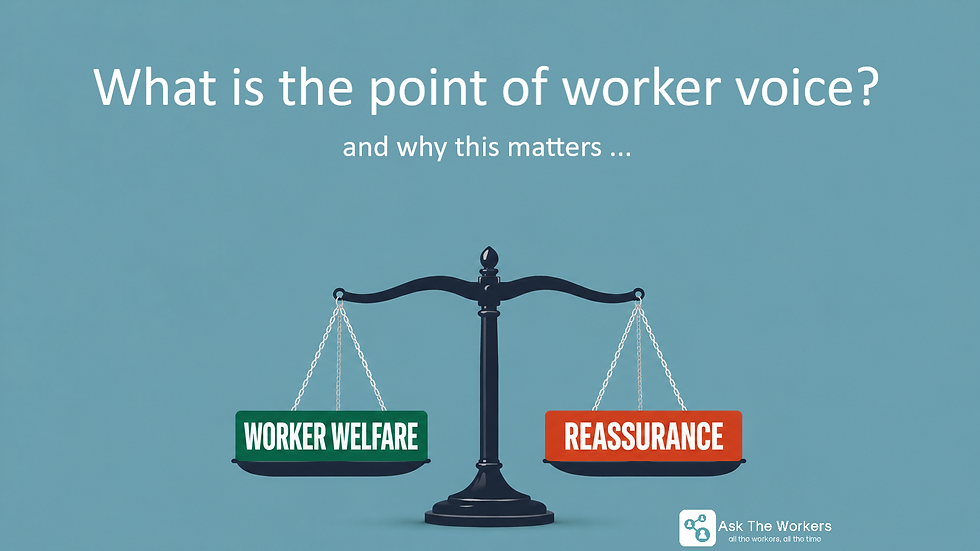
Here is what worker voice best practice looks like — and why it matters.
Start with the worker
The most effective worker voice programmes are built around commitments, not processes.

The sponsor — retailer, brand, landlord, franchisor, or financial institution — and each workplace should commit to delivering remedy if worker feedback indicates labour rights risks may be present.
And workplaces should commit to communicating regularly with workers about what has been heard.
These two commitments make the process meaningful. Effective worker voice is more than data collection.
Worker voice is a dialogue between workplaces and workers, with sponsors listening in.
That feedback cycle builds trust, drives participation, and delivers authenticity.
Design principles
From there, key design principles follow naturally:
anonymity (no email addresses, names, or phone numbers),
independence (workers respond in their own time),
regular feedback cycles, and
fair compensation for workers' time.
Compensation matters. The main reason for workers to provide feedback should be access to remedy if required. But better data is collected when workers respond away from the workplace, without management present - and so compensation for that independent effort is important.
And anonymity is essential.
Fear of reprisal is real — workers risk losing shifts, references, overtime, or employment if they are seen to raise concerns.
And anonymity is not just a promise. Workers must feel that they are anonymous and safe. Platforms that periodically geolocate workers - or which collect emails, phone numbers, or names - can compromise that feeling from the outset. If geolocation has to be used (eg: for seafarers) then its role and the extent of its use must be clearly explained (eg: locations are not stored if seafarers are on land).
Worker voice best practice means workers can authenticate without providing personal details.
The Better Work programme, a joint ILO/IFC initiative operating across eight countries, consistently finds that when workers share feedback safely and regularly — and see it acted upon — compliance outcomes, productivity, and retention all improve.
Continuous beats snapshot, every time
The single most important design decision in worker voice is whether a programme runs continuously or periodically.
Continuous wins — and it is not even close.
Continuous means workers provide feedback by responding to questions every day, via an app on their phones. There is no "survey" in the traditional sense. Worker feedback is continuous and without an end date.
Whilst individual workers might spend no more than a minute each time, because all the workers can be involved, all questions are answered every day by the workforce collectively. It is real-time data without breaks, supporting large and detailed question panels that can be varied periodically and across workplaces to understand better any salient risks uncovered.
The OECD's due diligence guidance is explicit:
meaningful stakeholder engagement should be ongoing, not reactive. Continuous worker voice is precisely that.
The practical advantages are significant.
Continuous systems detect coaching and manipulation in ways periodic surveys cannot.
Questions vary dynamically as findings develop.
Individual workplaces can receive customised question sets extended as needed when depth is needed.
Continuous is cheaper than surveys — the stop-start cost of periodic cycles is avoided entirely.
When remedy is delivered, its impact is measured in real time. And the presence of a continuous platform has a deterrent effect

Compared to surveys: spend less but get significantly better outcomes.
Analytics that surface what matters
Worker voice best practice on the analytics side means real-time, interactive dashboards that users control — not static reports built on assumptions they do not own.
Risk flags should surface automatically, telling users what to pay attention to without requiring them to sift the data themselves.
Methodology matters enormously.
Good analytics reveal vulnerable demographics who may be experiencing conditions differently from the majority.
Superficial comfort should not be built around simple average calculations that can hide feedback from vulnerable, minority groups. Relying on average scores is dangerous.
Mapping to the broader due diligence picture
Worker voice does not replace audits — it complements them.
Audits answer whether a policy exists. Workers tell you whether and how it is implemented.
Together they provide something neither delivers alone: a continuous, evidence-based picture of whether responsible sourcing commitments are real.
This is increasingly what regulators expect. The UN Guiding Principles on Business and Human Rights and the ILO's framework on worker representation both treat meaningful worker engagement as a core component of responsible business conduct — not a nice-to-have, but a baseline requirement.
What worker voice best practice delivers
The building blocks of worker voice best practice are not complicated — but they require discipline and genuine commitment to worker-centred design.
Workers already know where the issues are. Workers tell us, we tell you.
When programmes are built around the needs of workers rather than the convenience of sponsors, the results are compelling:
early sight of emerging risks,
real evidence that remedies are landing, and
continuous visibility that periodic assessments cannot provide
The opportunity — and increasingly the obligation — is to create the conditions where workers feel confident sharing that knowledge.
The sponsors that get this right are not just managing risk. They are building supply chains that are more resilient, more trustworthy, more productive, and more sustainable.
That is a genuinely exciting place to work towards.
Ask The Workers
Find out more about Ask The Workers and our commitment to worker voice best practice.
See how continuous worker voice delivers in practice. See how this post fits into the story of Worker Voice - click here for our guide to worker voice.
Contact us at info@es3g.com or book a call directly here.