
Worker voice for everyone
Updated: 5 days ago
What if worker voice for everyone could be achieved through a shared platform - similar to how social audits are shared through platforms like Sedex?
Worker voice is an increasing focus driven by laws and regulations in Europe, with the UK and other countries following close behind.
But a factory supplying five businesses today likely runs five different surveys at five different times via five different providers - if they run any surveys at all. That's because sharing has needed businesses to cooperate and no two businesses usually want the same thing.
Ask The Workers removes the need for cooperation.
It is one continuous channel in every workplace for every worker that can serve every business with an interest in them:
Each business can still decide what it asks, when it asks, and who sees the answers.
No need for agreements, no shared supplier lists, no surveys landing on workers from five different directions.
This is our "collect-once, share-many-times" model, similar to the "audit-once, share-many-times" model delivered by platforms like Sedex, Wrap, amfori BSCI and others.
If you are interested in joining a group of businesses that are looking to pool worker voice efforts - please get in touch with us here.

This post sets out how worker voice for everyone works.
Worker voice for everyone offers the flexibility we all need. And that's without complex agreements or sharing data, whilst delivering lower costs, better regulatory compliance, better coverage, and a much easier life for suppliers and workers.

Social audit - the precedent
Not everyone loves the "audit-once, share-many-times" model, but the platforms behind it work at scale.
Leading platforms are well-known, such as Sedex, Wrap, amfori BSCI, and they work like this:
The supplier arranges its own audit, usually to an accepted standard such as SMETA.
The audit report goes to the platform.
Businesses pay a membership fee and can see the reports for any supplier on the platform.
The platform adds services on top: dashboards, analytics, risk tools.
Sedex, this year, reported 100,000 businesses are now customers, with 120,000 workplaces on the platform and over 450,000 audits having been shared in its 21 year history (see here for the press release).
Why social audit sharing works
Three things make the audit-sharing model work, and all three need to be designed into a worker voice platform that can work for everyone:
Businesses do not need to cooperate
Each business decides on its own whether to join.
Members sign nothing with each other.
Nobody can see which suppliers another member is looking at, and in principle a business could be a member without any other member knowing.
Cooperation between competitors is hard; a decision to join a platform is easy.
Output is standardised
Members can accept and compare audit reports they did not commission because:
the social audit follows a standard protocol,
produces its results in a standard format, and
is carried out by an approved, affiliate, audit company.
Standards such as SMETA have enabled the audit-sharing proposition to scale.
"Audit-once, share-many-times" is infrastructure-sharing not data-sharing
Members do not need to share commercially-sensitive information to access and benefit fully from the service.
They are sharing the machinery through which audits are commissioned, collected and distributed rather than sharing any data of their own.
Worker voice for everyone: a single channel
Worker voice is harder to operate on a shared basis (compared to social audit):
There are no widely-accepted standards for worker voice surveys.
Workplaces themselves are not standard (farms, factories, mines, vessels etc).
The provider market is fragmented, with different methods that suit different situations.
Businesses have their own policies, priorities, capabilities and procedures.
Most importantly, the choice of which questions to ask
should be aligned with policies that can vary from one business to another, and
should match the capabilities of the audience to handle the responses, so that worker responses feed through into dialogue and appropriate actions where necessary.
There is no obvious "one-size-fits-all" approach. Whilst standards may emerge in future,
for now, a "worker voice platform for everyone" has to be flexible - and it has to work without requiring common standards to be agreed.
Ask The Workers has that capability.
Standardise the channel not the questions
Standardisation for worker voice has to sit in a different place from where it sits in audit.
It cannot sit in the questions, the timing, or the frequency. These need to be variable from one business to another and from one workplace to another.
Standardisation sits in the channel through which questions reach workers.
What we standardise is the methodology, the technology, the anonymity safeguards, and the way that responses are rolled up into standard measures.

This approach delivers all the flexibility required, whilst still enabling any one workplace to be compared with any other, and allows worker voice data to be set alongside audit findings (for example, mapping worker feedback to the ETI Base Code).
A single channel means there is one interaction with the supplier and its workers that can serve every business with an interest in that workplace, whatever the frequency, timing and scope of each business' requirement.
Ask The Workers is built to work this way natively - it is the single channel through which everyone's needs can be met.
One app on the phone
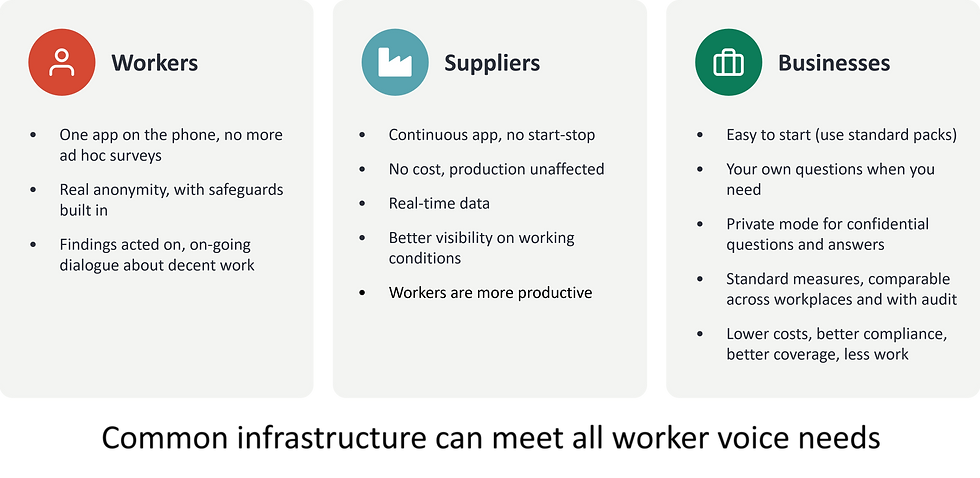
Here is a summary of what is required:
For workers:
One app on the phone only (no more ad hoc surveys)
Real anonymity with safeguards built-in
The app works the same way every day; it simply serves up whatever questions need answers that day (based on what questions business is looking to have answered that day)
Workers get a clear benefit - suppliers are incentivised to act on findings (if any) as appropriate given the audience with whom responses are shared.
If continuous worker voice is enabled (our recommendation, but not mandatory) then the platform provides a basis for dialogue between suppliers and workers to understand what remedies deliver worker satisfaction.
For suppliers:
One continuous app without any stop-start
No cost and no interruptions to production
Visibility of questions being asked of workers and their responses in real-time
An app that can safely support dialogue between the workplace and its workers
For business:
Start without drama - use the standard question packs available on the platform
Ask different questions in different workplaces (factories need different questions from farms, from fishing vessels, from mines - and some suppliers have local specifics)
Add or vary the questions at any time, and target them, if needed; subject to safeguarding, direct specific questions to:
go deeper into topics where findings might be emerging
specific groups of workers that are only relevant to them (for example: only ask deep-dive recruitment fee questions to workers who have reported that they paid a fee to get their job)
Take advantage of "bilateral mode" to add questions that are specific to your business:
Your specific questions get added into the daily flow
Other businesses do not see the questions and do not see the answers
Support pulse surveys alongside continuous background monitoring
Whatever the questions, get data rolled-up into standard measures so that workplaces can easily be compared to each other and to social audits (eg: map to the ETI base codes)
Ask The Workers delivers worker voice for everyone
These two posts give background on how we achieve these outcomes:
We call this the "collect-once, share-many-times" model - and it is available right now.
Where does this go?
Scaling worker voice has been difficult; it has not been low cost, managing and delivering surveys has required a lot of effort, and converting results into meaningful actions can mean waiting until the next survey happens. Moreover, it continues to impose a high overhead on suppliers.
"Worker voice for everyone" saves costs, increases compliance and coverage with little effort, and is significantly better for suppliers and for workers.
Not everyone will want to participate in a "Sedex for worker voice" - but this could be the approach that enables us all to start meeting the practical requirements of regulations in force today in Europe (eg: CSDDD, EU Forced Labour Regulation) and coming soon in the UK and elsewhere.
If you are interested in joining a group of businesses that are looking to pool worker voice efforts - please get in touch with us here.
Click here for our guide to worker voice which sets out more background and detail on these topics - and specifically looks at how data sharing can drive a more efficient worker voice market.
Contact us at info@es3g.com or book a call directly here.


