Grievance and continuous worker voice
Updated: Jun 18
There is increasing pressure on business to undertake "meaningful stakeholder engagement" to check that labour rights in supply chains are being respected - and that means connecting with workers directly.
So what would best practice look like here?
Would it be enough to implement a grievance mechanism?
In this post we explain some of the differences between grievance mechanisms and continuous worker voice - and why pairing them up is a powerful combination. We also explain why grievance, by itself, is not enough and is unlikely to deliver "meaningful stakeholder engagement".

Grievance
Many responsible sourcing programmes now include a grievance mechanism. These can vary from a system enabling workers to send messages to their employer through to worker hotlines and digital messaging platforms that direct messages to third party specialists in-country with local expertise to help resolve issues.
A well-implemented grievance mechanism can provide a strong safeguard for individual worker welfare. They can be expensive to implement well, since an effective mechanism requires trust to be built with workers so that they are comfortable using it, and local expertise to monitor and manage.
But relying on grievance mechanisms alone, even if well-implemented with independent, trusted and expert local supports, can end up providing false comfort when it comes to detecting systemic issues in workplaces.
"Meaningful stakeholder engagement" likely goes beyond grievance.
When silence is not a signal
There are several differences between grievance mechanisms and continuous worker voice. There is quite a long list - but here are two key points:
Low participation
If a grievance channel is receiving only few messages, does it mean there are only a few grievances? Does that mean things are good?
It might mean that workers do not have trust in the grievance mechanism.
That lack of trust can come via many routes, even with when systems are well-implemented. In a lot of countries, people have been conditioned from young age not to expect fair treatment when they complain since authorities and police forces can often be dismissive of individuals. Access to fair treatment can be unusual in wider society, let alone in the workplace. Moreover, if the grievance mechanism is operated by business rather than by a recognised, independent and worker-centric organisation, workers may well fear reprisals if they speak up.
With grievance, low participation can show as low grievances - which can be taken as a good result, but it may be a false flag.
With continuous worker voice, workers use the system to confirm good practice just as much to highlight matters they feel are not right. Low participation can happen if workers are not introduced to the app in the right way, or if there is no feedback process informing workers that their voice is being heard. But low usage of the app is not a signal that says "everything is okay".
This is a key difference between grievance and continuous worker voice.
With grievance, "low usage" of the grievance mechanism can be taken as good signal. But with continuous worker voice, low usage of the app is the opposite - worker trust in the app and confidence that it will benefit them needs to be built up.
We ask questions
A grievance mechanism typically requires workers to recognise that something is not right. Sometimes that is obvious - the boss should not be threatening workers or treating people unfairly. But for a call to be made to a grievance hotline, things needs to reach a point where an individual is spurred to action - which needs two things:
An understanding that this is something that is legimately wrong and that a complaint would be taken seriously
Sufficient pressure to act that overcomes any perceived risk of reprisals or potential for adverse outcomes
This reliance on the worker to act is a barrier to gaining feedback. It requires workers to be able to make an informed judgement and to have the pressure and courage to act.
Continuous worker voice also requires workers to have faith in it. Whilst workers are truly anonymous and should benefit from providing their feedback - there can still be a lack of confidence that suppresses participation; the good news is that this becomes clear quickly - see the previous point.
But a key difference between grievance and continuous worker voice is that we ask the questions. Workers do not have to think about whether
Collective versus individual feedback
Continuous worker voice is crowd-sourced data - truly anonymous.
As mentioned above, many workers are conditioned to understand that collective rather than individual action is safer and far more likely to be effective. They are reluctant to speak up individually but are comfortable in crowd.
And that's what continuous worker voice is.
But correspondingly, continuous worker voice is not the tool to identify risks or situations affecting individuals alone. Individual grievances are hidden in the crowd-sourced data.
Collective feedback -> continuous worker voice
Individual feedback -> grievance mechanism
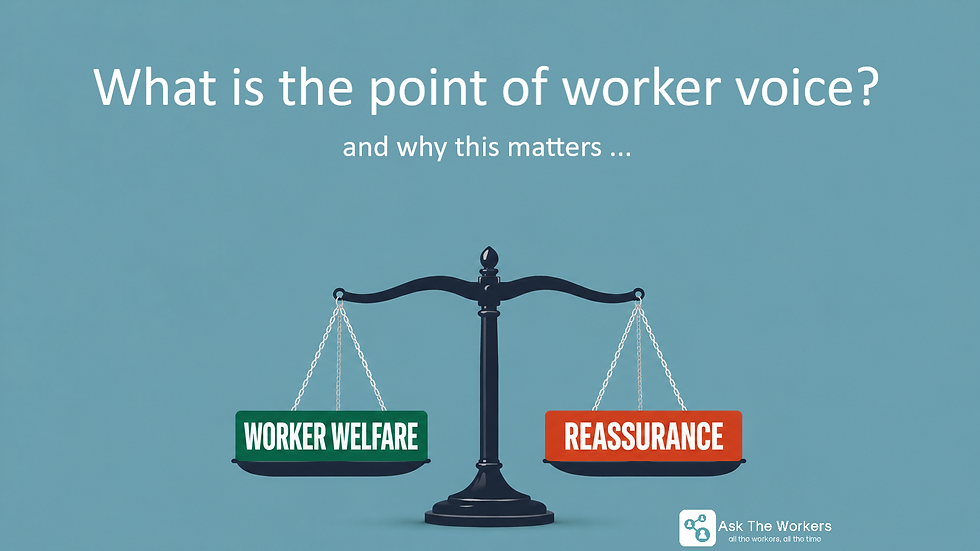
Best practice would be to have both.
Pair grievance with continuous worker voice
Pairing continuous worker voice with grievance is a strong combination - where each tool complements the other.
Where workers may be afraid to speak up or where signals may be intermittent - continuous worker voice steps up and fills the gap - crowd-sourced, collective data.
And vice versa - continuous worker voice is not suitable for identifying individual worker issues - where one worker is being singled out or experiencing personal problems in the workforce.
Do I need both?
Really, yes.
Grievance mechanisms are a strong worker welfare support - and should be implemented wherever possible using a "worker-first" approach and, if possible, managed by a recognised, trusted and independent third party.
But companies which rely on grievance mechanisms alone as their model for meaningful stakeholder engagement and to detect labour rights abuses are likely missing system issues and exploitative practices that workers either don't recognise or have been conditioned, as a community, to accept.
Find out more
Find out more about Ask The Workers, our commitment to worker voice best practice and how continuous worker voice can be deployed at low cost to enhance existing labour rights due diligence tools, like grievance mechanisms, social audits and SAQs.
Contact us at info@es3g.com or book a call directly here.